Back in March, the New York Times columnist David Brooks wrote an editorial about how the covid-19 pandemic might bring out the worst in people. You can read that piece here. In the editorial, Brooks refers to Daniel Defoe's book, A Journal of the Plague Year, which offers an account of the 1665 London plague, as told by a fictional saddler who had remained in the city while the wealthy fled. That reference led me to revisit this book that I had not read since college. I highly recommend reading it, as Defoe shines a light on human motivations and behavior that we see today in our own health crisis.
The saddler could have left London but chose to stay because he's convinced that God would preserve him "in the midst of all the death and danger that would surround me." "...If I attempted to secure myself by fleeing from my habitation, and acted contrary to these intimations, which I believe to be Divine, it was a kind of flying from God, and that He could cause His justice to overtake me when and where He thought fit." When his brother casts doubt on these convictions, the saddler reads the 91st Psalm, which led him to become more resolute than ever: "[F]rom that moment I resolved that I would stay in the town, and casting myself entirely upon the goodness and protection of the Almighty, would not seek any other shelter whatever; and that, as my times were in His hands, He was as able to keep me in a time of the infection as in a time of health...." Throughout the book the saddler shares his theological views, including his conviction that the plague is God's judgment and that a proper response to it involves spiritual meditation, humility, and repentance for one's sins. (In this respect, A Journal of the Plague Year is similar to Defoe's more well-known work, Robinson Crusoe, which is also quite theological in nature.)
A Journal of the Plague Year offers a masterful, vivid depiction of a diseased city and of the many different types of people living--and barely living--in it. Defoe's saddler plumbs the depths of human depravity, while also recounting numerous acts of kindness, mercy, and self-sacrifice. Still, what stands out in the narration are the lengths to which individuals will go to preserve themselves in the face of incomprehensible suffering and widespread death from disease.
Defoe, who was a mere five years old in 1665, wrote this account in 1721, when the Black Death was again threatening England. He was troubled that so many of his fellow citizens were seemingly indifferent to the danger. He wanted to warn them of the misery that was coming, and to share with them the lessons he thought people had learned from that earlier disaster.
What struck me, as I re-read the book, are the many parallels between scenes in the "journal" and events of today. We read about how the rich and wealthier citizens were able to flee the city with large stores of goods and food, and so escape the sickness, while the poor people were stuck. Business owners and family members are angry that the government has restricted their freedom. Defoe devotes many pages to the delusions of the masses. "The apprehension of the people were likewise strangely increased by the error of the times, in which, I think, the people, from what principle I cannot imagine, were more addicted to prophecies and astrological conjurations, dreams, and old wives' tales than ever they were before or since." It seems that conspiracy theories were as rampant in 1665 as they are today (and Defoe makes a point of stressing how those who devised these "follies" made some money in the process).
Out of desperation, citizens bought and used quack remedies, some of which caused the user to die. (On the day I was reading about those "remedies," President Trump was talking publicly about encouraging doctors to look into injecting disinfectant into people as a possible cure for covid; he also wanted scientists to investigate how to shine light and heat into sick peoples' bodies to serve as yet another "cure"....) The saddler: "There is no doubt but these quacking sort of fellows raised great gains out of the miserable people, for we daily found the crowds that ran after them were infinitely greater" than those who went to reputable doctors.
While the Saddler is quite religious and even occasionally theological (reflecting a form of Calvinism), he doesn't hesitate to criticize "bad religion." "Neither can I acquit those ministers that in their sermons rather sank than lifted up the hearts of their hearers...."
The saddler generally commends the government for having taken the public measures that it did "for the general safety, and to prevent the spreading of the distemper," although he concludes that shutting people up in their homes and restraining them did little good on the whole. The need for food and supplies ensured that the disease would spread: "...[N]othing was more fatal to the inhabitants of this city than the supine negligence of the people themselves, who, during the long notice or warning they had of the [plague], made no provision for it, by laying in store of provisions, or of other necessaries, by which they might have lived retired, and within their own houses, as I have observed others did, and who were in a great measure preserved by that caution.... [T]his necessity of going out of our houses to buy provisions was in great measure the ruin of the whole city, for the people catched the distemper on these occasions one of another, and even the provisions themselves were often tainted.... However, the poor people could not lay up provisions, and there was a necessity that they must go to market to buy, and others to send servants or their children; and as this was a necessity which renewed itself daily, it brought abundance of unsound people to the markets, and a great many that went thither sound brought death home with them."
Still, the saddler generally supports the government's actions for the sake of the public's overall good. In such a time of crisis, individual freedoms need to be curtailed.
Other parts of the book resonate with today's headlines, too: e.g., the lengthy complaints against the government's orders by business owners, whose businesses suffered and failed during the health crisis; the decision of individuals and families to leave their homes, visit taverns and eating establishments, and who thereby got sick (and got others sick) and died; the rise in theft and fraud; the poor who "went about their employment with a sort of brutal courage"; and so on.
It seems to me that someone could write the story of the covid-19 pandemic by using Defoe's template and even some of his pertinent paragraphs. A constant, common refrain in both books would be, "Lord, have mercy."
Monday, April 27, 2020


Tuesday, March 10, 2020
Photos from My Trip to Concordia-Portland
I spent last week in Portland, Oregon, smiling, laughing, and fighting back tears on the campus of my alma mater, Concordia University, which will soon be closing its doors for good. It was a bit of a pastoral visit, too, in order to share in the grief of friends who will be losing their employment at the end of April. Through watery eyes and despite my feeble attempts to offer a word of encouragement, there was also a lot of joy, as I was able to see quite a few friends, former colleagues, and abiding mentors. I also got to sit in on a class taught by one of my former students (the focus of which was Luther's understanding of "vocation"). A current Concordia student, who also happens to be the school's student body president, will be transferring to Valpo in the fall. She'll be continuing her degree in social work. (We shared a few laughs, as I told her about my own experiences in that same office long, long ago.)
Particularly meaningful were the precious minutes I spent contemplating the liturgical artwork that once hung on the chancel wall of Concordia's "Chapel of the Upper Room," a space that was later "secularized" and purposed for other aims. This art, which now hangs in the relatively new (!) library, is by Ernst Schwidder (1931-1998), who graduated from Concordia (high school) in the same class as my dad, the class of '49. Later, Schwidder taught art at Valpo, where he also created many sculptures and other artworks that hang today in church buildings, hospitals, and other venues around the country. So I definitely share "a sense of place" with Schwidder, a fellow Pacific-Northwesterner who was transplanted to the Midwest for a season. (Like the artist, I hope to return to my native country when my vocation here comes to its end.)

While in Oregon I was able to celebrate the 117th birthday of Edmund Schlink, whose 830-page "Ecumenical Dogmatics" will be the second volume in the collected works that I am editing and co-translating. Co-celebrating with me on the eve of that occasion was my co-translator, Hans Spalteholz. I first met him forty years ago, when I was a freshman at Concordia. On that day, we both were late for chapel. A year or two later he introduced me to Schlink, whose writings have now become intimately linked to us both. Here we are four decades later, still working together, still running late, still modeling the NW-plaid style of shirts we both like to wear, still learning from the famous Heidelberger. I’m deeply grateful for Hans' friendship and mentoring through the years. By God's grace, we will keep on plugging along.
"Happy Birthday, Dr. Schlink!" "R. I. P., Concordia-Portland!"
Particularly meaningful were the precious minutes I spent contemplating the liturgical artwork that once hung on the chancel wall of Concordia's "Chapel of the Upper Room," a space that was later "secularized" and purposed for other aims. This art, which now hangs in the relatively new (!) library, is by Ernst Schwidder (1931-1998), who graduated from Concordia (high school) in the same class as my dad, the class of '49. Later, Schwidder taught art at Valpo, where he also created many sculptures and other artworks that hang today in church buildings, hospitals, and other venues around the country. So I definitely share "a sense of place" with Schwidder, a fellow Pacific-Northwesterner who was transplanted to the Midwest for a season. (Like the artist, I hope to return to my native country when my vocation here comes to its end.)

While in Oregon I was able to celebrate the 117th birthday of Edmund Schlink, whose 830-page "Ecumenical Dogmatics" will be the second volume in the collected works that I am editing and co-translating. Co-celebrating with me on the eve of that occasion was my co-translator, Hans Spalteholz. I first met him forty years ago, when I was a freshman at Concordia. On that day, we both were late for chapel. A year or two later he introduced me to Schlink, whose writings have now become intimately linked to us both. Here we are four decades later, still working together, still running late, still modeling the NW-plaid style of shirts we both like to wear, still learning from the famous Heidelberger. I’m deeply grateful for Hans' friendship and mentoring through the years. By God's grace, we will keep on plugging along.
"Happy Birthday, Dr. Schlink!" "R. I. P., Concordia-Portland!"
 |
| Taking a Break from Translating Schlink's "Ecumenical Dogmatics" |
 |
| Checking a Definition in Cassell's |
The "Becker Brick" at Concordia Portland
At Concordia University, Portland, between Luther Hall and the Hagen Center, is a small circle of bricks that memorializes alumni and faculty. Here is a photo of the "Becker Brick" in that memorial courtyard:
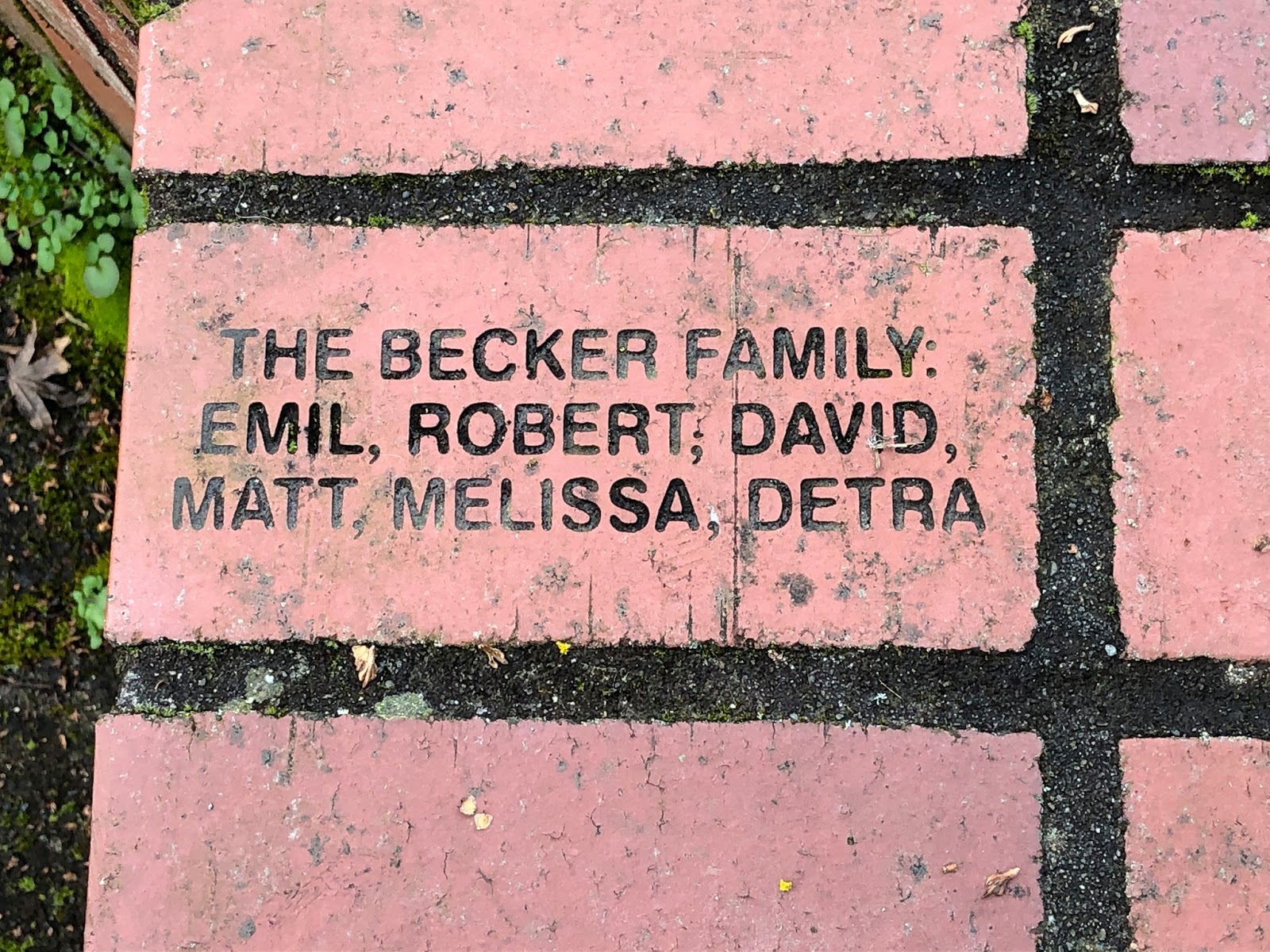
One night last week I was tempted to sneak onto campus with a chisel.... But that wouldn’t have been right— and the Portland PD would have easily found their prime suspect.
Still, I told some of my local friends, "Can you keep an eye on those bricks? My family and I would like to get ours back...."
Grandpa Emil - high school class of ‘18 (also on the university faculty in the 1930s)
Uncle Robert - high school class of ‘46
Dad David - high school class of ‘49
Yours truly- university class of ‘84 (also on the university faculty from '94 to '04)
Sister Melissa - university class of ‘91
Wife Detra - university class of ‘97 and ‘00
Friday, February 14, 2020
Further Details On CUP's Closure
A former president of one of the Concordias forwarded to me the following online article that gives quite a bit of new information (at least to me) about Concordia-Portland's closure.
https://www.insidehighered.
https://www.insidehighered.
Thursday, February 13, 2020
Christi Crux Est Mihi Lux
Forty years ago, I matriculated at Concordia College, Portland,
Oregon. By doing so, I was continuing a family tradition. My Grandfather Emil
had attended the school in the 1910s, my Uncle Bob had done so in the
mid-1940s, and my dad a few years after that. When I helped to research and
co-edit the chapter on Concordia for the book that commemorated the centennial
anniversary of the NW District of the LCMS, I learned that my grandfather had even taught at the college in the 1930s.[i] My wife, my sister, and one
of my cousins are also graduates of the institution, which today is called Concordia
University. Little did I know, when I was student-body president in '82-‘83 and
regularly representing my fellow students at monthly faculty meetings, that a
decade later I would join CUP’s faculty as a young assistant professor. During
the ten years that I taught theology and the humanities there and directed its
pre-seminary program, I was promoted to associate professor and then professor.
 |
| Luther Hall (photo copied from Concordia's webpage) |
I fully intended to serve at
Concordia until I retired, but that was not to be. Sixteen years ago, several
events led me to realize I needed to leave and seek a calling elsewhere. While
the accusations of “teaching false doctrine” followed me to Valpo, I was
protected here in ways that were not possible at Portland. Today I am grateful that
my family and I made the move in 2004, even though we really didn’t know what
would happen after that first year. Suffice it to say, the pastures have been greener, for all sorts of reasons.
But today I am also very sad, still in shock, really, for I
learned this week that my undergraduate alma mater, where I had also taught for
a decade, will be closing at the end of April. To read that announcement, you
can go here. To read an article on the closing, you can go here.
Just a few years ago, Concordia had 8,000 registered students—most of whom received their instruction entirely online. Only a small portion of those students lived on campus or commuted to their classes there. While I recognize that the Concordia I experienced as an undergraduate had to change, if it was to survive in these challenging times, the changes that it underwent were obviously not all for the good.
Part of the decline of the school, it seems to me, was the decision to move away from its core grounding in the liberal arts. There is no way that 8000 students, most of whom were studying completely online, could ever grasp or embrace the Christian-liberal-arts ethos that needed to remain at the heart of the school’s mission. By going in the direction it did, I feel that Concordia lost its soul, its center, its grounding, its focus. Hopefully someone someday will uncover the full details of the decline and demise of Concordia-Portland.
I would invite your prayers for those deeply affected by this
tragic development.
In the wake of this shocking news, I find myself also giving thanks for the classic, Christ-centered,
liberal-arts education I received at Concordia, for the leadership skills I
learned there, and for the love of learning that was faithfully and passionately
handed on to me. That kind of education may be going the way of the dinosaur. I'm grateful that I got to experience it when I did.
I’m thinking in particular of the professors who have meant so
much to me over these past four decades, whose lives and teaching have shaped
who I am, and who were absolutely crucial in helping me to discern my own vocation
in the church and the academy:
· Dick
Reinisch+, who taught me Latin and Greek; who transmitted a love for classical
culture; whose dry wit made education fun; who taught me the gospel as we
studied the Gospels and the letters of Paul; and who, each spring, competed
with me and a few others on the tennis court. (I will never forget the joyful
experience of meeting up with Dick and Irene in Greece in the summer after I had
graduated. I think of that trip every time my wife, who is Greek, serves us ouzo
or retsina. Dick made it possible for me to join CUP’s faculty, where I then
also taught Greek for that decade.)
·
John
Scheck, who taught me philosophy and American history; who as my academic adviser
patiently helped a struggling freshman mature just enough to get his academic
feet more firmly planted midway through his sophomore year; who transmitted a
love for the liberal arts and a hopeful vision of Christian humanism, one that included
a deep appreciation for the music of the church. John’s gospel-centered,
humor-filled preaching has remained the gold-standard model, the ideal.
·
Hans
Spalteholz, who taught me to love the Scriptures, to wrestle with them for the
sake of faithful interpretation, and to apply them to the world’s deep needs
and hurts; who taught me the distinction between law and gospel by unpacking
the theology of the Lutheran Confessions; whose love of books and learning and
of the German language has rubbed off on me; who pointed me the way to the
University of Chicago; who later also made room for me to join Concordia’s
faculty; who has become a second father to me, a spiritual counselor in times
of crises, and a comrade in various book projects.
·
Dick
Hill, who taught me the power of stories, of literature; who invited me to test
interpretations of American culture and history; who was the first to show me
how a film could be more than just a good visual experience; and who also encouraged
me to follow the academic path. Dick has become one of my closest friends.
·
Sid
Johnson, who, by meeting one-on-one with me every week during my freshman year
of humanities, taught me how to write; who helped me to discover my own voice; who
showed how the gospel can be dramatized; whose sermons are also gold standards
of evangelical proclamation.
· Frank Gebhardt, who instilled in me a love for rocks (I still have his geology textbook on my shelf!).
· Frank Gebhardt, who instilled in me a love for rocks (I still have his geology textbook on my shelf!).
·
Chuck
Kunert and Johnnie Driessner, who shaped my understanding of the sciences and
their relationship to Christian faith.
·
Julie
Rowland, whose spiritual depth and ecumenical spirit have been so influential
on my own Christian pilgrimage; who patiently helped a
mathematically-challenged sophomore to pass the math requirement.
·
E. W.
Hinrichs+, whose kindness and compassion were evident every day in the classroom,
and who taught me about Old Testament “Heilsgeschichte,” a concept that would
later be the subject of my doctoral dissertation (and first book).
·
Art Wahlers+,
who as “Mr. Concordia,” embodied the spirit of the place, the memory of the
institution, and who impressed upon me the importance of using concrete examples
and analogies in instruction and proclamation.
·
Dale
Fisk, whom I never had as a classroom teacher but whose musical leadership and vocal performances led me to experience the beauty and joy of classical Lutheran chorales (He knows that my
deepest undergraduate regret is that I never joined the choir.) [Addendum, 2/14: Tim and Nancy Nickel belong on this list, too, for they introduced me to a composer named J. S. Bach, whose musical offerings have become a part of my daily bread; indeed, this semester I am again teaching my course on Luther and Bach. I think of the Nickels and their own offertories given the the Chapel of the Upper Room, every time I walk to that class....]
·
Rhonda
Miller, who also modeled Christian humanism and humility; whose humor was infectious;
who also unveiled connections between drama and the gospel.
· Tom Wolbrecht, who as dean of students taught me about grace and compassion; who also taught me the basics of the Christian faith; who was an important mentor to me, especially when I served in student government.
· Tom Wolbrecht, who as dean of students taught me about grace and compassion; who also taught me the basics of the Christian faith; who was an important mentor to me, especially when I served in student government.
·
Larry
Gross, whose course on Christian art and architecture opened my eyes to the beauty
of grace and led me to journey through Europe with fellow Concordian, Steve
Chambers, in the summer of ’84. (In just a few weeks I’ll be co-leading a
six-week course on Christian art and architecture at my church, in preparation
for the European tour I’m leading in July.)
·
Dwaine
Brandt, who taught me Luther and Lutheran theology; who opened my eyes to the
great problems in German history, matters that have become the focus for my own
scholarly work.
·
E. P.
Weber+, who as president regularly took me to lunch to find out what the
students were thinking on this and that subject; who taught me the finer points
of synodical politics; who continually brought whatever conversation we were
having back to the questions, “so what?,” and “how does this issue/problem connect
to Christ and the gospel?”
The education I received has served me well as a pastor and professor. I’m grateful to all those who were my teachers in those years ('80-'84). Indeed, that is what the word "Concordia" means to me, the faculty and staff who embodied that "Christi-crux-est-mihi-lux" [“The Cross of Christ Is Light to Me”] liberal-arts tradition that was lovingly and faithfully passed on to me and my generation of students there. That tradition and motto live. A few of us are its "living letters" (cf. 2 Cor. 3).
The “spirit” of Concordia is nicely, beautifully captured in the school song, written by Professor Scheck. Permit me to end this post by quoting it here:
Out of darkness into the light of God
We have been brought by Christ our Lord.
Called by his Spirit into this fellowship
We work and pray with one accord.
Living together, serving each other
Striving always for harmony.
This is our motto, we of Concordia:
The cross of Christ is light to me.
[i]
Hans Spalteholz, Matthew L. Becker, and Dwaine Brandt, eds., God Opens
Doors: A Centennial Celebration of the Northwest District of The Lutheran
Church – Missouri Synod (Portland: Northwest District of the LCMS, 2000),
111-131. E. P. Weber, who had been president of the school for my first three
years there, wrote the bulk of that chapter (“You Must Grow Your Own”), but
Prof. Spalteholz and I made significant editorial adjustments to it, e.g.,
adding some references to individuals beyond Dr. Weber’s principal focus, which
was the school’s infrastructure and building projects. The quote, “You Must
Grow Your Own,” comes from an address that Dr. Francis Pieper delivered at the
1903 Northwest District Convention. When discussing the need for pastors in the
district, Dr. Pieper famously stated to the twenty-nine delegates, “You must
grow your own crop.” My grandfather was among the first pastors in that “home-grown harvest.”
My uncle and I also came back to the district to serve as pastors. My sister
served as a parochial-school teacher and my cousin as a director of Christian
education. Both are now working as public-school teachers.
Subscribe to:
Posts (Atom)